
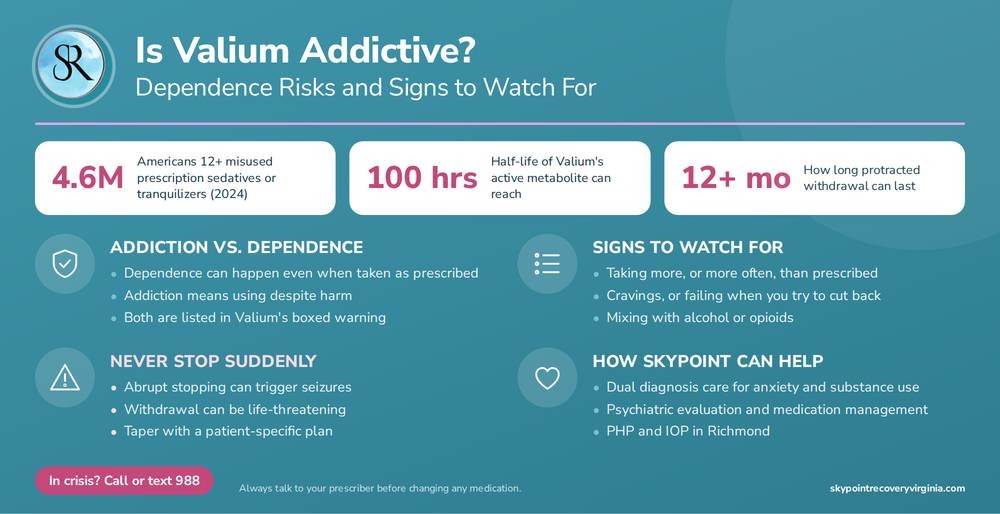
Yes, Valium (diazepam) can be addictive. It’s a Schedule IV controlled substance, and its FDA label carries a boxed warning, the agency’s strongest, for abuse, misuse, addiction, physical dependence, and withdrawal. Dependence can build even when you take Valium exactly as prescribed, and stopping suddenly can cause life-threatening withdrawal. Here’s how dependence and addiction differ, who’s most at risk, the signs to watch for, and how to stop safely.
What Valium Is and Why It’s Prescribed
Valium is a benzodiazepine, the same drug class as Xanax and Klonopin. It calms the nervous system by boosting the effect of GABA, a brain chemical that slows nerve activity. Valium is approved for:
- Anxiety disorders and short-term relief of anxiety symptoms
- Symptoms of acute alcohol withdrawal
- Muscle spasms, alongside other treatment
- Seizure disorders, alongside other medications
Many people start Valium for a real medical reason. That’s part of why dependence can sneak up on them.
Dependence vs. Addiction: What’s the Difference?
These two words get mixed up, but they mean different things, and you can have one without the other.
| Physical dependence | Addiction | |
| What it is | Your body adapts to Valium after repeated use | A strong urge to use and trouble controlling use, even when it causes harm |
| Can it happen when taken as prescribed? | Yes | It can |
| Main sign | Withdrawal symptoms when you cut back or stop | Cravings, loss of control, and continued use despite problems |
| What it needs | A gradual taper | A gradual taper plus treatment for the addiction |
Even taking benzodiazepines as prescribed may put people at risk for abuse and misuse.
How Addictive Is Valium Compared With Other Benzodiazepines?
All benzodiazepines carry the same boxed warning. What makes Valium different is how long it stays in your body. Diazepam has a half-life of up to 48 hours, and its active breakdown product, desmethyldiazepam, has a half-life of up to 100 hours. That’s much longer than Xanax, which averages about 11 hours.
A longer-acting drug doesn’t mean a safe one. Valium also builds up in your body with repeated doses.
Who’s at Higher Risk?
The risk of withdrawal reactions is higher for people who take higher doses and people who’ve taken Valium for longer. A joint clinical guideline on benzodiazepine tapering notes that withdrawal becomes a real risk after about three months of regular use, or after one to three months at moderate to high doses.
Be especially careful if you:
- Drink alcohol or use opioids or other sedating drugs while taking Valium
- Have a history of alcohol or drug misuse
Misuse is common, too. In 2024, about 4.6 million Americans age 12 and older misused prescription tranquilizers or sedatives, according to SAMHSA’s national survey.
Signs of Valium Addiction to Watch For
Watch for these signs in yourself or someone you love:
- Taking more than prescribed, or more often
- Running out of a prescription early
- Strong cravings, or trying to cut back and not being able to
- Needing more to get the same calming effect
- Mixing Valium with alcohol or opioids
- Feeling anxious, shaky, or unable to sleep when a dose is late or missed
- Pulling away from family, work, or activities
Other signs of misuse include confusion, memory problems, poor coordination, dizziness, and blurred vision.
Why Mixing Valium With Alcohol or Opioids Is Dangerous
Valium’s boxed warning says combining benzodiazepines with opioids can cause profound sedation, slowed breathing, coma, and death. Alcohol is also a problem, because it adds to Valium’s sedating effect. If you drink while taking Valium, read our guide on mixing diazepam and alcohol.
How to Stop Taking Valium Safely
Don’t stop Valium suddenly if you’ve been taking it regularly. Stopping suddenly or cutting the dose too fast can trigger acute withdrawal reactions that can be life-threatening, including seizures. Other symptoms include anxiety, panic attacks, insomnia, irritability, tremor, muscle pain, a racing heart, and sensitivity to light and sound. Some people have protracted withdrawal symptoms that last weeks to more than 12 months.
A safe plan usually:
- Uses a gradual, patient-specific taper
- Moves slowly, often starting with 5% to 10% reductions every 2 to 4 weeks, adjusted to how you feel
- Treats the anxiety, sleep, or pain problem underneath, so there’s something in place when Valium is gone
If you want to understand non-benzodiazepine options for anxiety, see our comparison of buspirone vs. benzodiazepines.
While your prescriber guides the taper, Skypoint Recovery in Richmond can help you treat the anxiety underneath.
How Skypoint Recovery Helps
If you started Valium for anxiety, that anxiety doesn’t go away when the pills do. Our dual diagnosis rehab treats anxiety or depression and substance use together. It includes psychiatric evaluation and medication management, plus CBT and DBT to build skills for managing anxiety without benzodiazepines. For more structure, our partial hospitalization program (PHP) gives you a consistent daily schedule of therapy while you return home each evening, and our Intensive Outpatient Program offers day and evening options.
If you’re worried about your Valium use, reach out to Skypoint admissions for a confidential conversation. If you’re in crisis, call or text 988.
Frequently Asked Questions
1. How long does it take to get addicted to Valium?
There’s no set timeline. Withdrawal becomes a real risk after about three months of regular use, or sooner at moderate to high doses, and the risk rises with higher doses and longer use.
2. Is Valium more addictive than Xanax?
Both carry the same boxed warning. Xanax is shorter-acting, while Valium lasts much longer in the body. Either one can cause dependence, addiction, and dangerous withdrawal.
3. Can you become dependent on Valium if you take it as prescribed?
Yes. Physical dependence can develop with regular use even at prescribed doses. That doesn’t mean you’re addicted, but it does mean you shouldn’t stop suddenly.
4. What happens if you stop taking Valium suddenly?
Stopping suddenly after regular use can cause withdrawal symptoms like anxiety, insomnia, tremor, and panic, and in serious cases seizures, which can be life-threatening. Always taper with your prescriber.
Related Blogs
-
 Is Valium Addictive? Dependence Risks and Signs to Watch For
-
Meth Withdrawal Symptoms: Timeline and What Helps in Early Recovery
-
Adderall Withdrawal: Symptoms, the Crash, and How Long It Lasts
-
Kratom Withdrawal: Symptoms, Risks, and When to Get Help
-
PHP vs. IOP: What’s the Difference in Levels of Care?
-
What is Family Therapy in Addiction Treatment, and How Does It Help?



Start Your Personalized Recovery Journey Now
 Call Us Now