
Packing for treatment is one of those things people worry about more than they need to. For rehab, you'll want your photo ID, insurance card, a list of your medications and comfortable clothes. If you're moving into sober living or transitional housing, add about a week of clothes, toiletries and laundry supplies. Leave alcohol, drugs, weapons and valuables at home, and if you're not sure about something, just ask our admissions team. Below, we'll cover what to bring to rehab, what to leave at home, and the essentials for a shared recovery house.
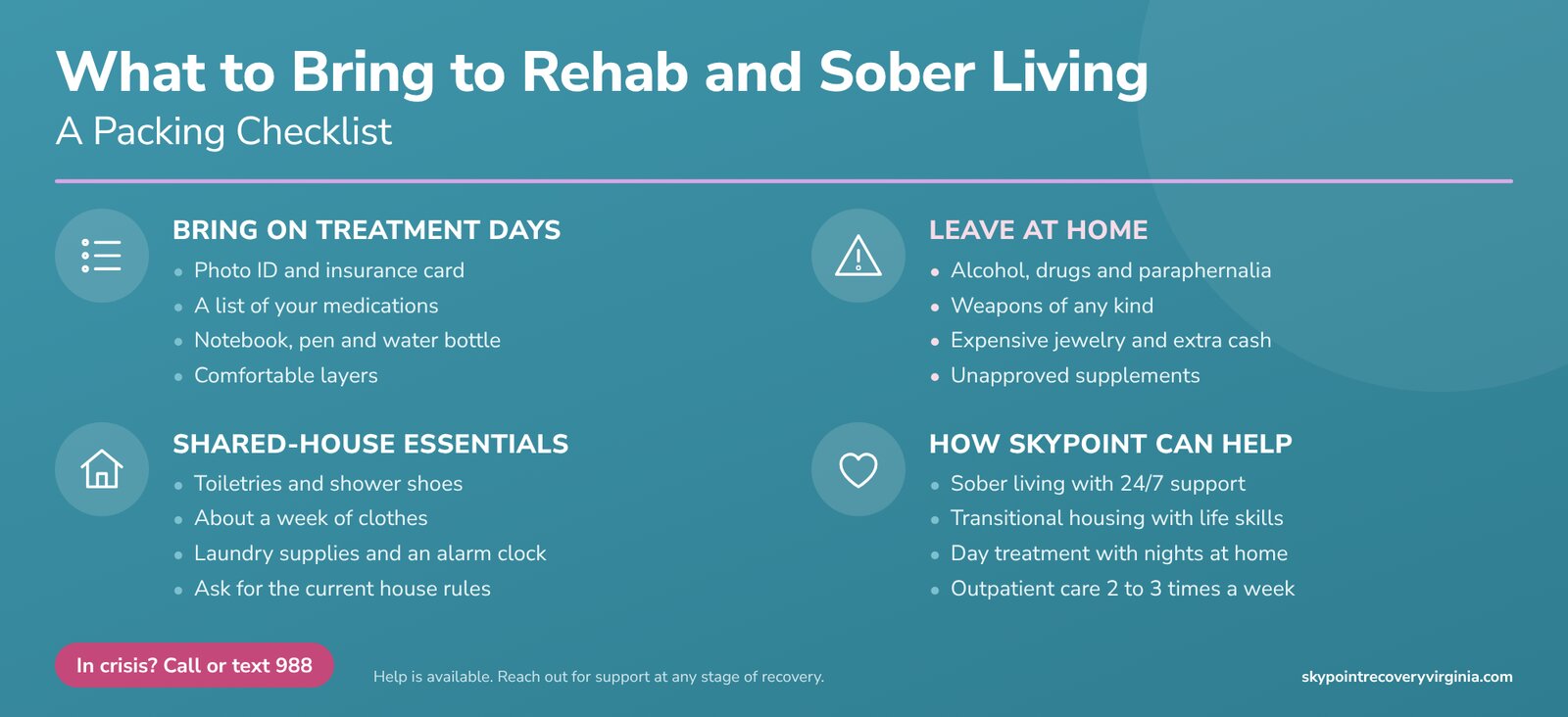
What to Bring to Rehab on Treatment Days
In a day program, you don't need to pack like you're leaving for a month. At Skypoint Recovery Virginia, clients in the partial hospitalization program return home each evening, and the intensive outpatient program meets 2 to 3 times a week, with day and evening options. So your daily bag can stay light.
| Item | Why it helps |
|---|---|
| Photo ID | Needed at check-in and for insurance |
| Insurance card (front and back) | Helps the admissions team confirm your coverage |
| A list of your current medications | Gives your care team doses and prescribers in one place |
| Notebook and pen | Useful for therapy homework, goals and things you want to remember |
| Water bottle and a snack | Keeps you comfortable through a full day of sessions |
| Comfortable layers | Rooms can feel warm or cold, and you'll be sitting a lot |
| Emergency contact information | Names and numbers for the people you trust most |
Ask admissions whether meals are provided and what the current phone policy is, so you know whether to pack lunch and how to plan around calls during sessions.
Your Documents Checklist
Paperwork is the part people forget most often, and it's the part that can slow down your first day. Gather these before you start:
- Government-issued photo ID: A driver's license, state ID or passport
- Insurance card: Bring the physical card, plus the name of the policyholder if it isn't you
- Medication list: Each medication's name, dose, how often you take it and who prescribed it
- Prescriptions in their original bottles: Pharmacy labels help staff confirm what each one is
- Contact information for your providers: Your primary care doctor, therapist or psychiatrist
- Work or school forms: Any leave paperwork your employer or school needs completed
If you're not sure what your plan covers, the admissions intake form asks for your insurance company, plan type, member ID and group number. Having your card in hand makes that step quick.
What to Pack for Sober Living or Transitional Housing
Moving into a shared recovery house takes more planning. You're setting up a home, and you're sharing it with other people who are working on their recovery too.
One common surprise for new residents is how much daily routines matter. Keeping your room clean, doing your share of chores, getting up on time and handling your own laundry can feel small. In a shared house, those habits become part of how you rebuild structure. Pack with that in mind.
| Area | Shared-house essentials |
|---|---|
| Bedroom | Bedding and pillow if not provided, alarm clock, a small reading lamp, hangers |
| Bathroom | Toiletries, shower shoes, a shower caddy, towels, a basic first aid kit |
| Laundry | Detergent, a laundry bag or basket, enough clothes for about a week |
| Kitchen | A labeled water bottle and travel mug, plus any food storage containers the house allows |
| Daily routine | A planner or calendar, a phone charger, a reusable bag for groceries |
| Comfort | Photos, books, a journal and clothes for exercise |
Pack clothes for different weather, plus one or two outfits you'd wear to a job interview or appointment. If you're working toward a new job, you'll be glad you have them.
Before you move in, ask admissions for the current house rules and the official packing list. Each house can have its own guidelines about visitors, curfews, shared spaces and what you can keep in your room. If you're still deciding whether a shared house is right for you, our guide to how sober living works explains the basics.
What Not to Bring to Rehab
Most programs share a few basic restrictions, though the details vary. This list covers the items that commonly cause problems:
| Leave at home | Why |
|---|---|
| Alcohol, drugs and paraphernalia | Recovery spaces are substance-free for everyone's safety |
| Products that contain alcohol, like some mouthwashes and sanitizers | Many programs restrict them, so check before you pack |
| Weapons of any kind | Not allowed in treatment or shared housing |
| Expensive jewelry and large amounts of cash | Easy to lose in a shared space |
| Supplements or over-the-counter medications not cleared by your care team | They can interact with prescribed medications |
| Clothing with drug or alcohol references | Can be triggering for others in recovery |
When in doubt, leave it out. It's much easier to have something brought to you later than to send an item home.
What Virginia Law Says About Recovery Residences
If you're moving into a sober living home in Virginia, it helps to know how the state defines and oversees them. Under Virginia Code § 37.2-431.1, a recovery residence is housing that's free of alcohol and illicit drugs for people with substance use disorders, including those with co-occurring mental health conditions. It doesn't provide clinical treatment itself.
A few parts of the law are useful for residents and families:
- Certification is required. No one may operate a recovery residence in Virginia unless the state's behavioral health department has certified it.
- There's a public list. The department posts the certified residences on its website, along with each one's credentialing organization.
- You have a right to know who credentials the house. Each residence must share that information with prospective residents.
- Residents can't be required to use paid services that benefit the house. A residence can't make you use medical or clinical services it profits from as a condition of living there.
These rules give you a simple way to check that a house meets state standards before you unpack.
Sober Living Checklist: Your First Week
A little preparation makes the move-in feel calmer. Use these steps as a guide:
- Ask admissions for the current packing list and house guidelines.
- Gather your documents and medications in one folder or bag.
- Pack about a week of clothes, plus laundry supplies.
- Label personal items like water bottles, chargers and food containers.
- Introduce yourself to your housemates and ask how chores are shared.
- Set a daily routine that includes treatment, meals, sleep and some time outside.
If you're still feeling nervous about the treatment side of things, our post on what to expect in rehab walks through the first call, the assessment and a typical day in treatment.
How Skypoint Recovery Virginia Helps
Skypoint Recovery Virginia in Richmond pairs day and outpatient treatment with substance-free housing, so you can rebuild daily routines while you stay in treatment.
- Sober living. Our sober living homes in Richmond offer a drug-free place to live with peer accountability, life skills that build independence, and a team available 24/7 for guidance and support.
- Transitional housing. Transitional housing includes workshops on job searching, resume writing, budgeting and cooking, plus peer support and shared community activities.
- Partial hospitalization. Our partial hospitalization program offers individual, group and family therapy, CBT and workshops, and clients return home each evening.
- Intensive outpatient. Our IOP meets 2 to 3 times a week, with day and evening options, so you can keep up with work or family.
Want the current packing list or house guidelines? Ask admissions for your packing list and our team will walk you through what to bring and what happens on your first day.
Frequently Asked Questions
Can I bring my phone to rehab?
It depends on the program. Many outpatient programs let you keep your phone but ask you to silence it or put it away during sessions. Ask admissions about the current policy before your first day.
What should you not bring to rehab?
Leave alcohol, drugs, paraphernalia and weapons at home. Many programs also restrict products that contain alcohol, unapproved supplements, large amounts of cash and expensive jewelry. Your program's admissions team can give you its exact list.
Can I bring my own medication to rehab?
Usually, yes, as long as it's prescribed to you. Bring each medication in its original pharmacy bottle and a written list of doses and prescribers. Your care team will review everything to make sure it's safe with your treatment plan.
What do I need to move into sober living?
You'll need your ID, insurance card, medications, about a week of clothes, toiletries, laundry supplies and any bedding the house doesn't provide. Ask the house for its rules on visitors, curfews and shared spaces before you move in.
The Bottom Line
Packing is one of the few parts of recovery you can fully plan ahead. Keep your list simple, ask admissions what's allowed, and you'll know exactly what to bring to rehab and your new home.
Related Blogs
-
 What to Bring to Rehab and Sober Living: A Packing Checklist
-
Signs of Drug Use: What to Look For and What to Do Next
-
Can You Force Someone Into Rehab? Options for Virginia Families
-
How to Help an Alcoholic Loved One: What Works and What Backfires
-
Is Valium Addictive? Dependence Risks and Signs to Watch For
-
Meth Withdrawal Symptoms: Timeline and What Helps in Early Recovery



Start Your Personalized Recovery Journey Now
 Call Us Now